Living things · Ages 7+ · 20 min · Kholo Plus
Brain & senses
Light up the lobes, send a pulse down a nerve, and see why your hand moves before you say ouch.
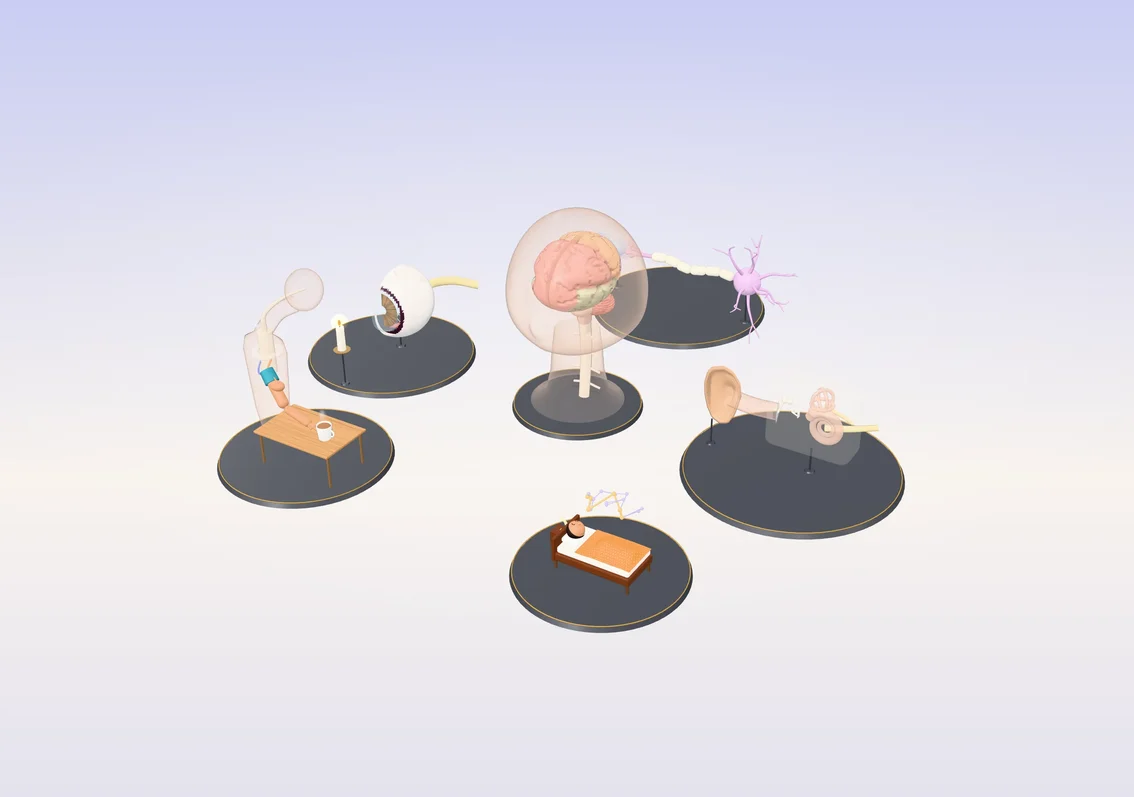
What is inside
- The brain. A folded lump of about 1.4 kg that thinks, feels, remembers and runs your whole body — in its hard skull, like a walnut in its shell.
- Neurons and signals. A nerve cell: little branches to receive a message, a long wire to carry it, and a tiny gap where it jumps to the next cell.
- The eye. A ball about 2.3 cm across. Light comes in through the pupil, the lens bends it, and an upside-down picture lands on the retina at the back.
- The ear. Sound is air wobbling. The ear catches the wobble, makes it bigger with three tiny bones, and turns it into signals in a snail-shaped tube.
- Reflexes and the spinal cord. Touch something hot and your hand jerks away before your brain even knows — the spinal cord answers on its own.
- Sleep, memory and learning. Every time you practise, the connections between neurons get stronger. While you sleep, the brain replays the day and saves what matters.
Stories in this thing
- What happens when you catch a ball. Eyes, brain, balance and muscles — in half a second
- A message along a nerve. One neuron, one pulse, one tiny gap
- How you see this screen. Light in, picture upside down, brain flips it
- How you hear your name. Air wobbles, a drum shakes, a snail shell listens
- Hand on a hot cup. Why your hand moves before you say ouch
- Why sleep helps you remember. Practice makes paths, sleep saves them
School topics it covers
- Brain & nerves
- Eye & ear
- Reflexes
How children use it
Pull it apart with one slider, tap any part to hear what it does, follow a short story read aloud, then answer a few questions. Every thing comes with experiments to try at home and study notes linked to the NCERT chapter it supports.
More things to open
- Human body — 12 systems, 700+ parts — grow from baby to grandparent.
- Living cell — The tiny factory you are made of — 30 trillion times over.
- Mango tree — Roots, pipes and leaves that cook food from sunlight.
- Solar system — Why it is night, why summer is hot, and how Chandrayaan reached the Moon.
- Satellite — Why it never falls down, and how TV comes from space.
- Family car — Follow one drop of petrol from the tank all the way to the wheels.