Space · Ages 6+ · 20 min · Free
Solar system
Why it is night, why summer is hot, and how Chandrayaan reached the Moon.
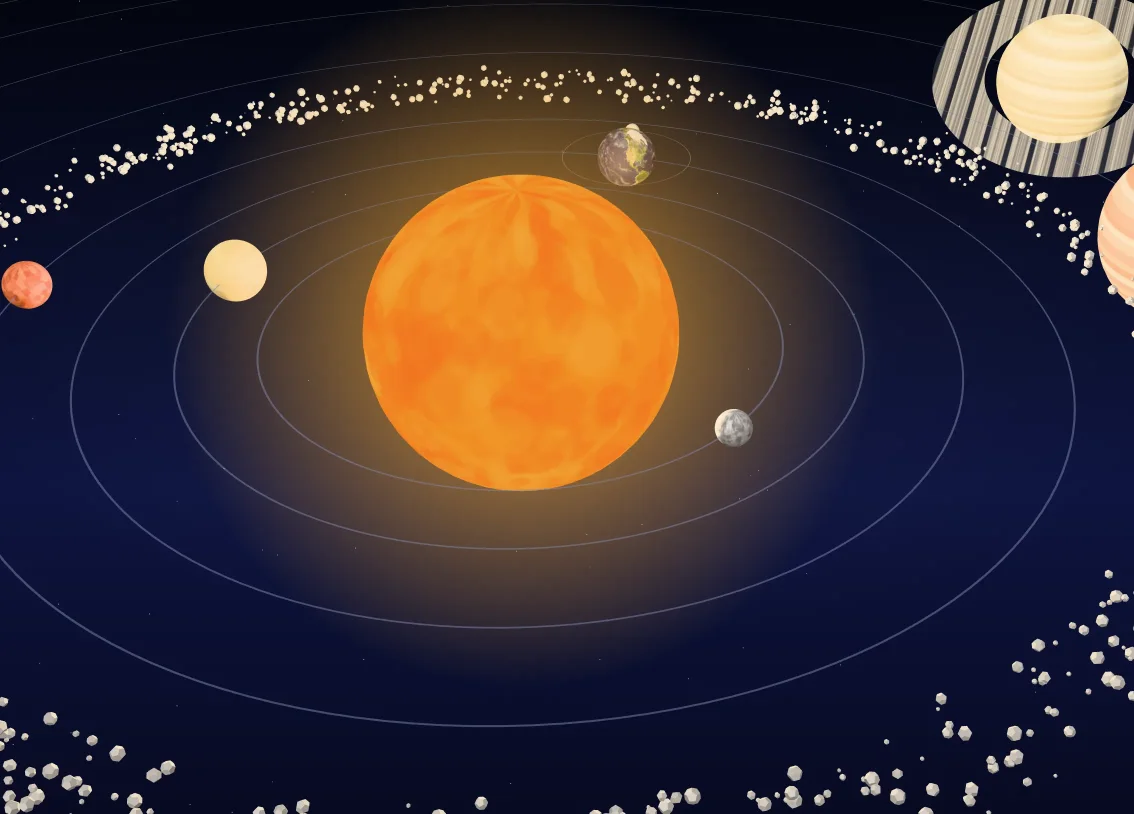
What is inside
- The Sun. A star: a giant ball of glowing gas that gives every planet its light and warmth.
- Rocky planets. Mercury, Venus and Mars: small, rocky worlds near the Sun.
- Earth & Moon. Our planet, tilted and spinning, with the Moon going round it once a month.
- Asteroid belt. Millions of rocks between Mars and Jupiter — leftovers from when the planets formed.
- Gas giants. Jupiter and Saturn: huge planets made mostly of gas, with no ground to stand on.
- Ice giants. Uranus and Neptune: cold blue worlds at the edge of the planets.
- ISRO’s missions. Chandrayaan to the Moon, Mangalyaan to Mars, Aditya to watch the Sun.
Stories in this thing
- A tour of the planets. From the Sun to Neptune, in order
- Why is it night?. Earth spins, and half of it faces away
- Why is summer hot?. Earth is tilted
- The Moon’s changing face. New moon to full moon and back
- An eclipse. When a shadow falls on the Sun or the Moon
- Chandrayaan’s road to the Moon. How India landed at the Moon’s south pole
- The life of the Sun. Born from a cloud, and what comes after
School topics it covers
- Day & night
- Seasons
- Moon & eclipses
How children use it
Pull it apart with one slider, tap any part to hear what it does, follow a short story read aloud, then answer a few questions. Every thing comes with experiments to try at home and study notes linked to the NCERT chapter it supports.
More things to open
- Rocket — Ride ISRO’s LVM3 from countdown all the way to space.
- Satellite — Why it never falls down, and how TV comes from space.
- Aeroplane — How 70 tonnes of metal takes off, cruises and lands.
- Cruise ship — Why steel floats — and the secret crew corridor inside.
- Electricity — From the power station to your switch — and what happens when you flick it.
- Smartphone — Pull it apart into seven layers — the screen, the chip, the battery and the radios that carry your voice.